DECARBONIZATION
With ceramic
high-temperature technology
Reduce CO₂.
Ceram develops high-performance substrates for carbon capture applications, which are already in use in several pilot plants worldwide. The focus is on maximum specific surface area, low mass, and long service life, because for us, CO₂ is not waste, but a valuable raw material.
OUR TECHNOLOGY
Decarbonization doesn't start tomorrow; it's already measurable today.
Every ceramic heat storage unit and every catalyst from Ceram Austria reduces the energy and fuel requirements of industrial processes. Regenerative Thermal Oxidation (RTO) recovers process heat with up to 97 percent thermal efficiency and enables autothermal operation without auxiliary fuel, while optimized process control simultaneously reduces gas and electricity consumption. According to our own estimates, Ceram products used worldwide prevent approximately 5 million tons of CO₂ per year and also reduce 125,000 tons of nitrogen oxides.
Ceram is developing the next generation of high-performance substrates for carbon capture applications, which are already in use in several pilot plants. The materials science focus is on an extremely high specific surface area that securely binds applied sorbents or MOFs, as well as low mass to accelerate desorption cycles. Low manufacturing costs for the ceramics ensure the economic viability of the process, while a long service life guarantees the return on investment and promotes the principles of the circular economy. Ceram regards CO₂ as a valuable raw material that should neither be emitted unused nor permanently stored.
Catalytic Processes
- Regenerative Heat Recovery: Ceramic honeycomb bodies cyclically store and release process heat. A thermal efficiency of up to 97% and autothermal operation reduce the gas consumption of RTO systems by up to 45%.
- Efficient Process Control: The heat storage bed and cycle time are matched to the mass flow and energy content of the exhaust gas, up to autothermal operation without auxiliary fuel. Optimized process control reduces gas and electricity consumption and thus the CO₂ footprint of the overall process.
- Low Pressure Drop: The hexagonal HEX-Cell geometry offers approximately 72% more heat exchange points with lower pressure drop. The reduced fan power leads to 10 to 15% lower energy consumption compared to standard cells.
- Durability & Regeneration: Long service life and the regeneration of used catalysts through the CATLife® program extend the lifespan of the ceramics used, conserve resources, and avoid the emissions associated with producing new ceramics.
RESEARCH AND DEVELOPMENT
What is developed in the lab today enables industry tomorrow.
Decarbonization is our biggest research focus. We combine our two core functions, catalysis and heat storage, into solutions that drive the energy transition and simultaneously comply with emission standards. Here, we present only developments that have already reached project stage, from high-temperature heat storage to ceramic carriers for CO₂ capture. The common base material for all these approaches is ceramics, which are characterized by thermal stability, scalability, and long service life.
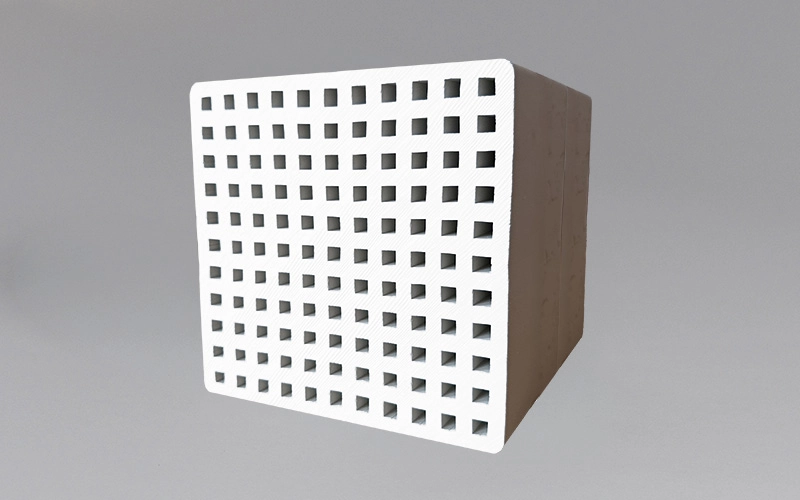
SOLARSTONE
High-temperature heat storage for providing process heat (Power-to-Heat)
Excess green electricity is converted into heat in a ceramic storage medium and released as process heat when needed. The high-capacity SolarStone is used as the storage medium, offering significant CAPEX advantages over lithium batteries as a stationary storage unit with an energy density of approximately 0.4 MWh/m³.
Function: Power-to-Heat | Overall efficiency: 70–85% | Softening point: > 1,300–1,600 °C
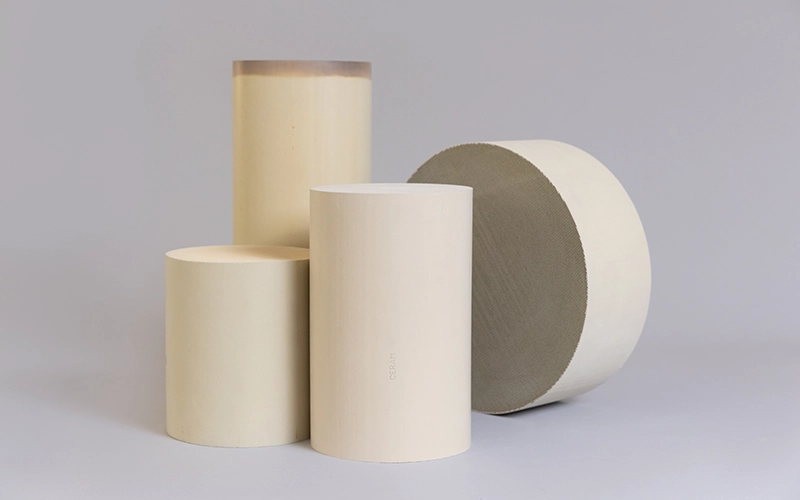
DIRECT AIR CAPTURE
Ceramic carrier body for direct CO₂ capture from the air (Direct Air Capture)
CO₂-binding sorbents are applied to the specially developed honeycomb body. Ceram, as an R&D partner, develops the technical ceramic material, with high stability, an optimized pore system, and cost-effective production being the central development goals.
Function: DAC carrier body | Pilot project: 10,000 elements, USA pilot plant
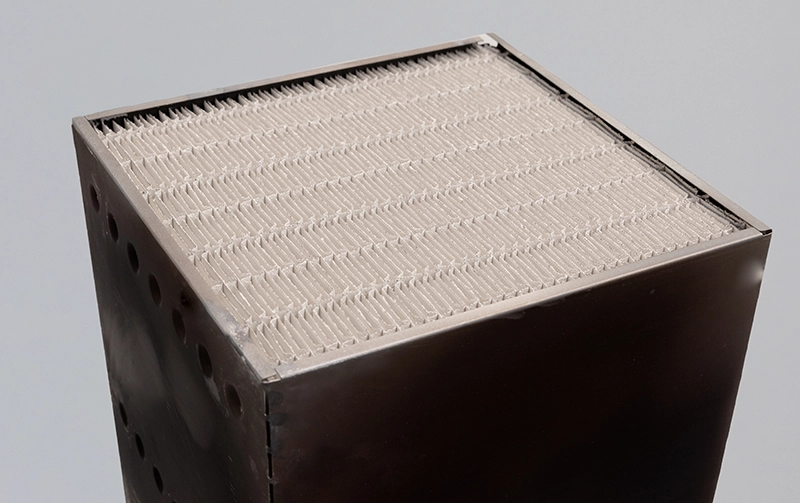
MOF SUBSTRATES
Ceramic carrier media for coating with Metal-Organic Frameworks (MOF)
The structured honeycomb ceramic offers the mechanical stability and optimized pore system that make MOF coatings scalable for industrial applications. This opens up application possibilities in CO₂ capture, VOC concentration, gas sweetening, and gas-gas separation.
Function: MOF carrier medium | Applications: CO₂ capture · VOC · Gas separation | Basis: Structured honeycomb ceramic
High-performance ceramic technologies for exhaust gas cleaning, heat storage, and decarbonization.
Expertise in ceramic processing since 1921.
Gamserstraße 38 · 8523 Frauental a. d. Laßnitz
office@ceram-austria.com · +43 3462 2000-0
TERMS AND CONDITIONS
CERTIFICATIONS
ISO 9001
ISO 14001
ISO 45001
ISO 50001
ISO 3834-2