
CERAMIC HEAT STORAGE FOR THE PROCESS INDUSTRY
Reduce over 99% of VOCs
in exhaust gas
and recover heat.
In surface technology and the process industry, solvent-containing exhaust air streams are generated that must be treated through thermal oxidation. RTO systems oxidize over 99% of these VOCs and recover the released heat with up to 97% thermal efficiency.
INDUSTRY CHALLENGE
Burn volatile organic compounds while reducing energy consumption.
In the process industry and surface technology, operators face a dual requirement: volatile organic compounds (VOCs) must be reliably reduced, while energy costs must remain manageable. Regenerative thermal oxidation (RTO) fulfills both requirements in a single system.
RTO systems are used wherever VOC-containing exhaust air must be treated safely and completely: in painting and coating plants, in wood processing, and in pharmaceutical and semiconductor manufacturing.
The decisive difference compared to purely thermal oxidation lies in the integrated heat recovery. A ceramic heat medium stores the energy released during combustion and returns it to the incoming exhaust air stream. As a result, RTO systems achieve very high thermal efficiency and, in ideal cases, can be operated completely autothermally, i.e., without any additional energy input.
Regulatory and market drivers
- VOC & Solvent Directives: The Industrial Emissions Directive (IED) and solvent emission requirements limit the emission of volatile organic compounds.
- Energy Cost Pressure: The gas consumption of exhaust air purification is a direct cost factor and an RTO system reduces this significantly.
OUR SOLUTION
Ceramic heat media, optimized for the application.
Ceram manufactures ceramic honeycomb bodies for RTO systems in various material and geometry variants, each optimized for performance and cost in the specific application. As a technology leader in heat storage honeycombs, Ceram supports its customers with decades of experience in dimensioning, design, and operation. Specially shaped blocks ensure uniform flow through the system, allowing high utilization of the heat storage without unfavorable temperature gradients.
A material for every requirement
Five material families – NT, LA, MK, CR, and HT – cover the entire range of requirements: from high chemical resistance and pronounced thermal shock resistance to use at temperatures of up to 1,500°C. Thus, the right honeycomb is available for every thermal and chemical load.
HEX Cell Technology
HEX cells offer the densest channel packing per area: approximately 15% more channels at the same hydraulic diameter, about 72% more active heat exchange points, and in total 10–15% less gas consumption compared to square cell types.
WHY CERAM AUSTRIA
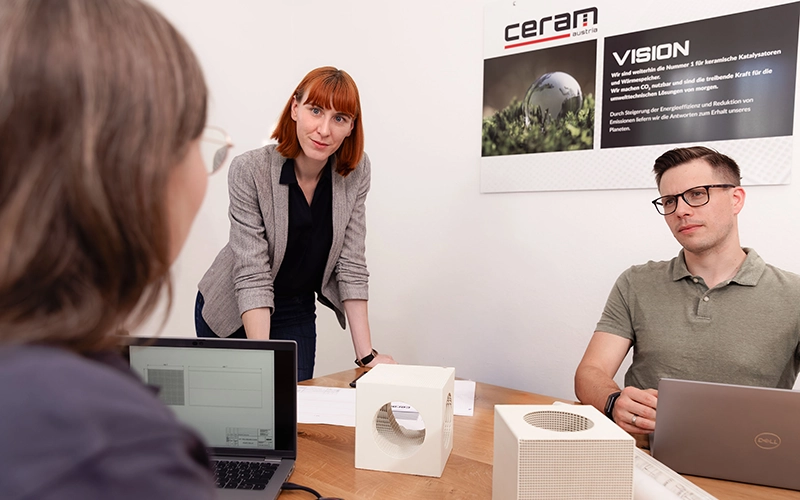
Material, cell type, and cell geometry are designed based on the requirements for VOC concentration, temperature, and efficiency targets.
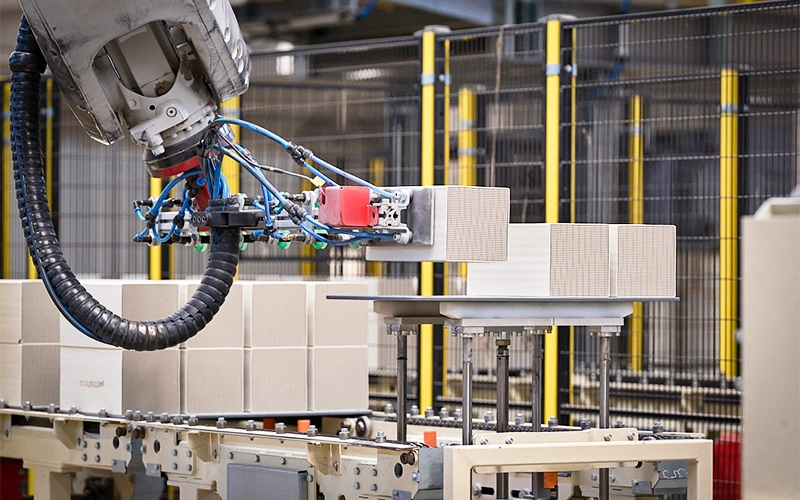
The development and series production of all products take place at the Ceram site in Frauental, Austria. Ceram has a wide range of standard solutions to ensure short delivery times, high quality, and low product costs.

Ceram provides advice on material selection, efficiency, and the replacement of heat media throughout the entire service life of the RTO system, as well as assistance in the event of malfunctions and support in analyzing damaged honeycombs.
CONTACT
Your RTO system, your process —
let's talk about it.
Describe your application, your VOC concentration, as well as the composition and temperature window. Our experts will design the right ceramics for your system, precisely dimensioned and delivered on time.

High-performance ceramic technologies for exhaust gas cleaning, heat storage, and decarbonization.
Expertise in ceramic processing since 1921.
Gamserstraße 38 · 8523 Frauental a. d. Laßnitz
office@ceram-austria.com · +43 3462 2000-0
TERMS AND CONDITIONS
CERTIFICATIONS
ISO 9001
ISO 14001
ISO 45001
ISO 50001
ISO 3834-2